what mathematical concept were the indians the first to use?
Information technology should come up as no surprise that the starting time recorded use of the number nothing, recently discovered to exist fabricated as early equally the 3rd or 4th century, happened in Republic of india. Mathematics on the Indian subcontinent has a rich history going back over three,000 years and thrived for centuries before similar advances were made in Europe, with its influence meanwhile spreading to China and the Middle Eastward.
Every bit well every bit giving united states of america the concept of zero, Indian mathematicians made seminal contributions to the report of trigonometry, algebra, arithmetic and negative numbers among other areas. Perhaps near significantly, the decimal organization that we nevertheless utilise worldwide today was starting time seen in India.
The number system
As far back equally 1200 BC, mathematical cognition was being written down as part of a large body of knowledge known every bit the Vedas. In these texts, numbers were commonly expressed as combinations of powers of x. For example, 365 might be expressed every bit three hundreds (3x10²), vi tens (6x10¹) and five units (5x10⁰), though each power of ten was represented with a proper name rather than a set of symbols. It is reasonable to believe that this representation using powers of x played a crucial role in the development of the decimal-place value organization in India.

From the third century BC, we besides have written evidence of the Brahmi numerals, the precursors to the modern, Indian or Hindu-Arabic numeral system that about of the globe uses today. Once zero was introduced, almost all of the mathematical mechanics would be in place to enable aboriginal Indians to study higher mathematics.
The concept of null
Zero itself has a much longer history. The recently dated first recorded zeros, in what is known as the Bakhshali manuscript, were simple placeholders – a tool to distinguish 100 from 10. Similar marks had already been seen in the Babylonian and Mayan cultures in the early centuries Ad and arguably in Sumerian mathematics as early as 3000-2000 BC.
Merely merely in India did the placeholder symbol for nothing progress to become a number in its own correct. The appearance of the concept of nil allowed numbers to exist written efficiently and reliably. In turn, this allowed for effective tape-keeping that meant important financial calculations could be checked retroactively, ensuring the honest actions of all involved. Aught was a meaning step on the route to the democratisation of mathematics.

These attainable mechanical tools for working with mathematical concepts, in combination with a strong and open up scholastic and scientific culture, meant that, by effectually 600AD, all the ingredients were in identify for an explosion of mathematical discoveries in India. In comparison, these sorts of tools were not popularised in the West until the early 13th century, though Fibonnacci'south book liber abaci.
Solutions of quadratic equations
In the seventh century, the kickoff written evidence of the rules for working with null were formalised in the Brahmasputha Siddhanta. In his seminal text, the astronomer Brahmagupta introduced rules for solving quadratic equations (then beloved of secondary school mathematics students) and for computing foursquare roots.
Rules for negative numbers
Brahmagupta also demonstrated rules for working with negative numbers. He referred to positive numbers as fortunes and negative numbers as debts. He wrote down rules that take been interpreted by translators as: "A fortune subtracted from nil is a debt," and "a debt subtracted from naught is a fortune".
This latter statement is the same equally the rule nosotros learn in school, that if you subtract a negative number, it is the same as adding a positive number. Brahmagupta also knew that "The production of a debt and a fortune is a debt" – a positive number multiplied by a negative is a negative.

For the large part, European mathematicians were reluctant to accept negative numbers as meaningful. Many took the view that negative numbers were absurd. They reasoned that numbers were developed for counting and questioned what you could count with negative numbers. Indian and Chinese mathematicians recognised early that one answer to this question was debts.
For example, in a primitive farming context, if i farmer owes another farmer 7 cows, then finer the first farmer has -7 cows. If the showtime farmer goes out to buy some animals to repay his debt, he has to buy 7 cows and give them to the 2d farmer in order to bring his cow tally dorsum to 0. From so on, every cow he buys goes to his positive total.
Basis for calculus
This reluctance to adopt negative numbers, and indeed nada, held European mathematics back for many years. Gottfried Wilhelm Leibniz was ane of the first Europeans to use zero and the negatives in a systematic way in his development of calculus in the late 17th century. Calculus is used to measure rates of changes and is important in almost every branch of science, notably underpinning many key discoveries in modern physics.
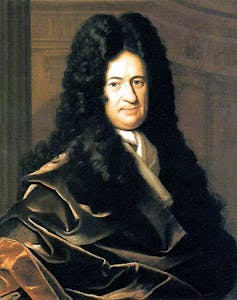
Just Indian mathematician Bhāskara had already discovered many of Leibniz'due south ideas over 500 years earlier. Bhāskara, also made major contributions to algebra, arithmetics, geometry and trigonometry. He provided many results, for instance on the solutions of sure "Doiphantine" equations, that would non be rediscovered in Europe for centuries.
The Kerala school of astronomy and mathematics, founded by Madhava of Sangamagrama in the 1300s, was responsible for many firsts in mathematics, including the utilise of mathematical induction and some early calculus-related results. Although no systematic rules for calculus were adult by the Kerala schoolhouse, its proponents first conceived of many of the results that would after be repeated in Europe including Taylor series expansions, infinitessimals and differentiation.
The leap, made in Bharat, that transformed zero from a simple placeholder to a number in its own right indicates the mathematically enlightened culture that was flourishing on the subcontinent at a time when Europe was stuck in the dark ages. Although its reputation suffers from the Eurocentric bias, the subcontinent has a strong mathematical heritage, which information technology continues into the 21st century by providing key players at the forefront of every branch of mathematics.
Source: https://theconversation.com/five-ways-ancient-india-changed-the-world-with-maths-84332#:~:text=As%20well%20as%20giving%20us,was%20first%20seen%20in%20India.
0 Response to "what mathematical concept were the indians the first to use?"
Post a Comment