Why Does Ridley Make You Get the Marks Again and Again
How Ridley Missed His Mark: Robin Hood, Part 1
Posted by Jennine Lanouette on Tuesday, May 25th, 2010
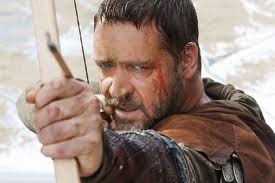 Here'south Ed and I walking out of the theater after seeing Robin Hood.
Ed: Well . . . I accept one skilful thing to say about it.
Me (brightly): Oh, yeah? What'due south that?
Ed: It employed 855 people.
Lately, Ed has been counting the names in the credits at the finish of movies. Maybe because I make him sit through them. If I call back right, Imaginarium of Doctor Parnassus was 700, Alice was effectually 800 and Avatar was a whopping 1400 and something. So that's where Robin Hood stands on that score.
I gauge Ed didn't like the moving-picture show much. My feelings weren't quite and so extreme. Information technology had some great actors – Cate Blanchett, Eileen Atkins, Max Von Sydow, William Hurt (squeamish to see him on the screen again) and a personal heart throb of mine – Matthew Macfadyen (although under-utilized in this pic). Russell Crowe, at this betoken, is a given in Ridley Scott films so no surprises there.
I also enjoyed seeing yet another interpretation of life in medieval times. All bawdy and ragged with the barest touches of color and course. These characters had less greasy hair than some medieval envisionings, simply more body odour. I specially liked the fashion the "ballsy" boxing scenes were at the same fourth dimension kinda small. The castles were very compact. The armies were a manageable horde. The roads through the dark woods were rather narrow. Reminding us that we took up a lot less space on this planet, in one case upon a time.
I certainly acknowledge, however, that the script fell short of its mark, so to speak. I had already gleaned as much from the lackluster reviews, much to my disappointment. So, by the time I got to run into information technology, my intent was non so much to have a surpassing experience equally it was to discern what information technology'south mistakes might have been.
I of Ridley Scott'south hallmarks as a manager is the thinking person'due south activeness flick, Thelma & Louise and Blackness Hawk Down being two good examples. Just those were both explicitly topical, meaning that the action was there to serve the intellectual query. Are women justified in responding to male aggression with aggression of their own? Should America intervene in internecine foreign conflicts for humanitarian goals?
The greater claiming is to brand a thinking person's action film that is conceived as pure entertainment. This is the apotheosis that Scott was able to reach with Gladiator. Even so, in doing so, he ready the bar very high for himself. He made a film that was high-octane spectacle while besides working in artful layering, human resonance and greater pregnant than all the slash and fire. Sadly, he did non run into his own standard with Robin Hood. I think this is at the core of all the collective moaning well-nigh this motion picture. So what exactly was missing?
The answer, in a word, is theme, an essential ingredient in any thinking person's film and the level on which Robin Hood misfired badly. This is peculiarly unfortunate since the Robin Hood fable is nada if non thematic, operating, as it does, from the premise that it is justifiable to steal from the over-fed rich if you lot are doing and then to serve the starving poor.
But, in my ascertainment, theme is non something you lot want to have merely statically sitting on summit of your story. You don't want to just have information technology as a given that Robin Hood is the guy who stole from the rich to give to the poor. This is, in fact, a limitation of the Robin Hood story, as it has ever been told. It becomes monotonous. How many times can you watch the Merry Men conduct out their escapades before it just becomes the same old story over and once more. It becomes like a perpetually-happy-ending television bear witness.
Theme is all-time utilized when it is made agile, which is to say when it has a progression from starting time to end. So Ridley Scott's instincts were right to start with Robin Hood'due south beginnings. Then you have someplace to get. The overriding question becomes, How did he go to the detail moral opinion that made him Robin Hood?
Near of us will do what'south right when confronted with an injustice suffered by one who matters to usa, and we are the only one who can help, and nosotros take the means with which to practice and so. Merely taking a stand when nosotros don't have to? When no one'south looking? For a complete stranger? Just for the hell of it? No thanks. Think I'll just stay here in my comfy little life. So why does this Robin Hood guy do all that running effectually helping people in need just for the hell of information technology?
In that location's a question to explore! And what are we given in this film as an answer for it? Showtime, nosotros see Robin Longstride being asked by Rex Richard if God would have approved of the Crusades. Robin says no, and describes a moment when an sometime Muslim woman, about to be slaughtered, looked on him with pity considering she knew they had become godless. The Male monarch responds past calling him honest, brave and naïve.
Oops, now we have a trouble. The man is highly principled at the kickoff. And aware of his principles and willing to have a stand against the King for them. Where are we going to go from hither? It'due south that self-sensation thing once more. Too much, besides soon. I would have rather he started out all wrapped up in his comfy little self-protective values. Then I might have been genuinely surprised to meet him gradually metamorphose into someone who goes out on a limb for others. And I might take fifty-fifty been inspired by it.
This is the other trouble with Scott'due south Robin Hood: In a word, graphic symbol. Nosotros don't see any character progression in the course of the story. Ane measure of this is, every bit already noted, he is as hostage and principled in the beginning as he is at the end. Another measure is that all of the gains he does achieve are external – bringing the barons and king together to defeat the French, saving the village from the plunderers, winning the affection of Marian and creating his outlaw do-adept community. So we take achieved much in the expanse of plot and action. Only we haven't gone anywhere with either theme or character.
Call up back in college English language class reading Shakespeare's Henry the Quaternary, Parts I and II? . . . No? . . . Me neither. I read them much later on. Anyway, possibly you've heard of the scallywag Prince Hal and his sidekick Falstaff who spend almost the entire first play getting into trouble in brothels and taverns while Hal's earnest, kingly father is out disposed to the very serious business of defending the realm. At the finish of the first play, immature Hal finally proves himself in battle and is reconciled with his male parent. Then, in the 2d play, Hal distances himself from the profligate Falstaff and begins assuming the responsibilities of being a king. And in the third play (Henry V), he proves to be a very constructive male monarch, something few would have predicted in his youth.
Role of what makes Robin Hood and so irresistible in the fable is the mischievous and delighted way in which he goes about his redistribution programme. What if his pre-enlightened cocky was but mischievous and cocky-satisfied without the noble purpose? And what if under all that fun-loving roguery, he was actually a very aroused immature man? And then we would take a distance to travel with him. What if, to take this fifty-fifty farther – and I'k going to make a huge leap here – part of why he's and so angry is because he is the illegitimate son of Richard the Lionheart? And what if everyone knows it because the resemblance is so stark. (Of grade, then the film would take to be cast with Charlie and Martin Sheen or Keifer and Donald Sutherland or the like. Hmm. Might take to rethink that one.)
I could encounter creating a Robin Hood who is merely irresponsible and roguish to start. Then, when external circumstances bear downward upon him, such as existence wronged past Prince John and such, he becomes outwardly angry and dour. This is compounded when he begins to become weighed downwards by the injustices in the world. He feels powerless, and becomes bitter and resentful. Then he has his first opportunity to steal from the rich (such every bit reclaiming the seed corn from the church) and he has fun for the first time in months (or years). This is the get-go of his new career path. And we have a merrier Robin than Russell Crowe was able to give u.s..
This is the big reward of working off the Robin Hood legend – no one knows who he actually was or where he came from. So why not pose a "what if?" that gives him plenty of reason to have a chip on his shoulder? Some people are born to be leaders, most people are not. So in Robin nosotros take a born leader who, if born legitimately, would have been a perfect heir to the throne. Meanwhile, Richard has no legitimate heir, and so the fate of the people falls into the easily of that miscreant Prince John. See how this makes the conflict with Prince John personal? That lends considerable help to the external conflict, as well every bit being grounded in Robin'southward internal life.
But I'm just playing effectually hither. Monday morning quarter backing, every bit information technology were. I don't presume to know what actually would have saved this motion-picture show.
……………………………………………………………………………………………………………
You can sentry Robin Hood on the following Video On Demand websites:


……………………………………………………………………………………………………………
Source: https://www.screentakes.com/how-ridley-missed-his-mark-robin-hood-part-1/
0 Response to "Why Does Ridley Make You Get the Marks Again and Again"
Post a Comment